

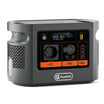
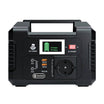

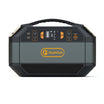
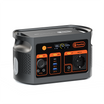


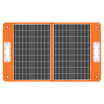
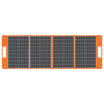


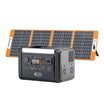

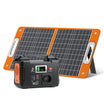

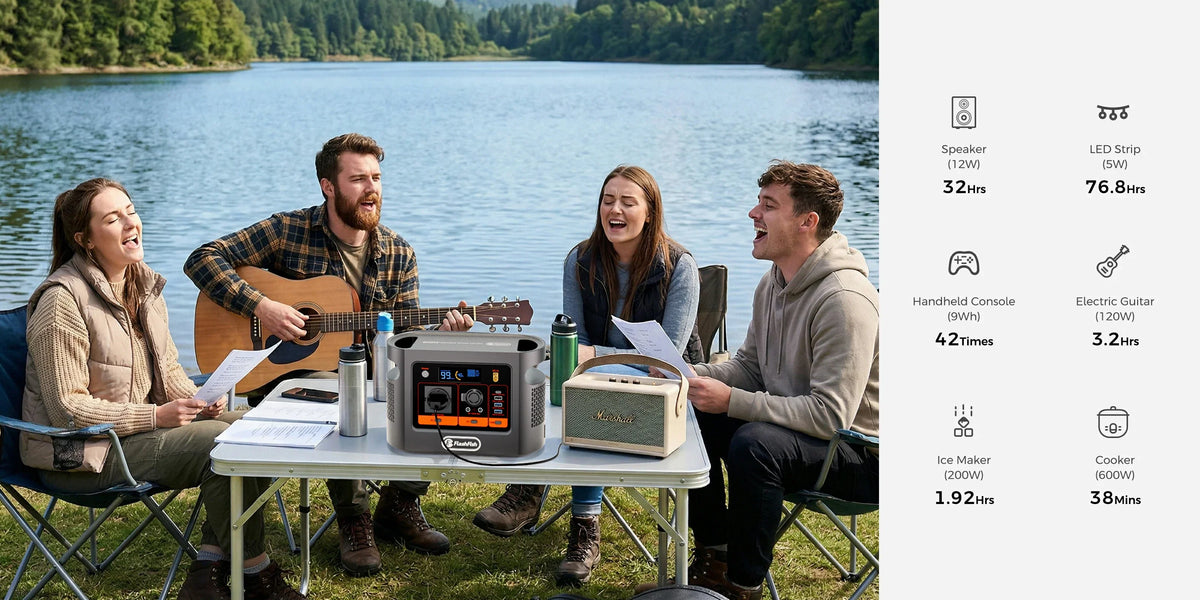
Short answer: do not start with battery size. For car-free camping, start with what is actually orderable, then weigh the complete kit and verify how each device charges. A101 is the lightest paper option at 1.2kg, but its standalone variant was unavailable in the fresh Europe snapshot. P66A is a 2kg, 144.34Wh option for modest verified loads. E106B raises nominal energy to 384Wh and continuous pure-sine AC output to 600W, but the station alone weighs 5.2kg.
The decision method is CARRY-CHARGE-LOAD: confirm live availability, calculate the weight you will carry, map every charging path, and then choose the smallest output and energy class that passes the exact load sheet. This prevents a light station with the wrong port—or a capable station that makes the walking section miserable—from becoming the wrong purchase.
Decision table for a car-free camping kit
| Decision factor | A101 | P66A | E106B |
|---|---|---|---|
| Fresh Europe availability | Standalone unavailable; solar-kit variant sellable | Standalone and kit variants sellable | EU-plug and kit variants sellable |
| Station mass | 1.2kg | 2kg | 5.2kg |
| Nominal energy | 97.68Wh | 144.34Wh | 384Wh |
| Continuous AC | 120W | 200W | 600W pure sine wave |
| USB-C path | Two ports, up to 18W PD each | One 18W QC port; PD not documented | One 100W PD and one 30W PD port |
| Best reason to shortlist | Lowest paper carry mass if the available configuration and ports fit | Low-mass current purchase for modest AC/USB loads | More energy and headroom when the extra 3.2kg versus P66A is justified |
Current product check: compare the currently orderable P66A and E106B, then open the E106B details. Treat the A101 page as an availability check, not proof that the standalone station can currently be ordered.
CARRY: weigh the whole route, not the product card
Station mass is only the first line. Add the tent, sleeping system, water, food, phone, laptop or camera, adapters, cables, protective case and any solar panel. Record the longest walking transfer, stairs and platform changes. Eurostar is one example of an operator that expects passengers to carry permitted luggage and fit it into the available space; another operator or route can apply different rules. Check the exact carrier rather than turning a product's capacity or page title into transport approval.
CHARGE: connector shape is not the power contract
A101 documents two USB-C ports up to 18W Power Delivery. P66A documents 18W USB-C Quick Charge, not PD. E106B documents one USB-C PD port up to 100W and another up to 30W. A USB-C plug therefore does not prove that a laptop or camera charger will negotiate the required profile. Copy the exact device input and cable rating; if the USB path is not supported, check the approved AC adapter against the station's continuous AC ceiling.
LOAD: build one measured trip sheet
| Item | Evidence to record | Decision |
|---|---|---|
| Phone and headlamp | Battery size, charger input, cable and number of sessions | Use direct USB only when protocol and power match |
| Laptop or camera charger | Approved adapter or USB-C PD profiles and maximum input | Choose USB-C or AC; do not count both |
| Camp lighting | Actual watts, hours used and whether it is rechargeable | Measure one representative evening |
| Reserve | Energy left for route disruption, phone and safe shutdown | Do not plan to zero |
Three concrete car-free camping examples
- Phone, headlamp and camera batteries: a low-power USB-first kit may make the lightest station class attractive, but A101 standalone availability currently fails. P66A is the lower-mass sellable station to screen, provided its actual USB and charger paths match.
- USB-C laptop plus lights: if the laptop documents a compatible profile up to 100W, E106B has the clearest direct PD path and more nominal energy. The trade-off is 5.2kg before any camping gear is added.
- Uncertain mixed group gear: if adapters and load labels are still missing, none of the three is a confirmed fit. Reduce the device list, collect evidence and keep a mains or no-power fallback instead of buying extra watt-hours blindly.
When FlashFish fits
- P66A fits a modest, fully labelled kit when lower carry mass matters and approved charging paths stay within its documented limits.
- E106B fits when a compatible 100W USB-C laptop path, 600W continuous AC headroom or 384Wh nominal energy justifies the additional mass.
- A101 can return to the shortlist only when the exact required configuration is sellable and its 120W/18W paths fit the real devices.
When it does not fit
- The operator has not confirmed the item is permitted on the exact route.
- The plan assumes a product title, connector shape or nominal Wh proves compatibility.
- The station or connections would be exposed to rain, damp ground or an unsuitable tent electrical setup.
- The complete pack is too heavy for the walking transfers or accessible-luggage limits.
- The trip has no fallback for an unavailable product, failed cable or higher-than-expected energy use.
Frequently asked questions
Is A101 the automatic choice because it is lightest?
No. A101 is the lightest at 1.2kg, but its standalone variant was unavailable in the fresh Europe snapshot. Its 120W AC ceiling and 18W USB-C PD ports also need to match the exact kit.
Can P66A charge a USB-C laptop directly?
Do not assume so. The authoritative P66A record identifies 18W USB-C Quick Charge, not Power Delivery. Check the laptop profile and use its approved AC adapter only when the complete load fits.
Does E106B make sense for every train camping trip?
No. E106B offers more nominal energy and AC headroom, but the station alone weighs 5.2kg. Add the tent, water, food, laptop, adapters and cables before accepting that carry burden.
Can these stations be used outdoors in rain?
This guide makes no weather-resistance claim. Keep the station, sockets and connections dry, follow the manual and stop when the site or weather cannot support a dry electrical setup.
How many nights will each station last?
There is no fixed answer. Nominal Wh is not delivered device energy, and the result changes with load, conversion path, use pattern, temperature and reserve. Measure the intended kit before the trip.
Before booking the route: ask FlashFish Europe to confirm your exact travel kit, then check the transport operator and campsite rules yourself.
Sources and evidence limits
Checked 14 October 2026. Product facts come from the authoritative local records and current Europe Admin/product routes. Eurostar supplies one operator-specific carry example, and the Camping and Caravanning Club supplies general campsite electrical guidance. No transport operator, campsite, device kit, weather exposure or runtime was tested for this article; the image shows E106B at a campsite and is not a three-model or car-free-transport test.


Laisser un commentaire
Ce site est protégé par hCaptcha, et la Politique de confidentialité et les Conditions de service de hCaptcha s’appliquent.