

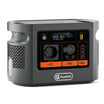
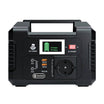

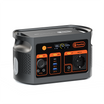






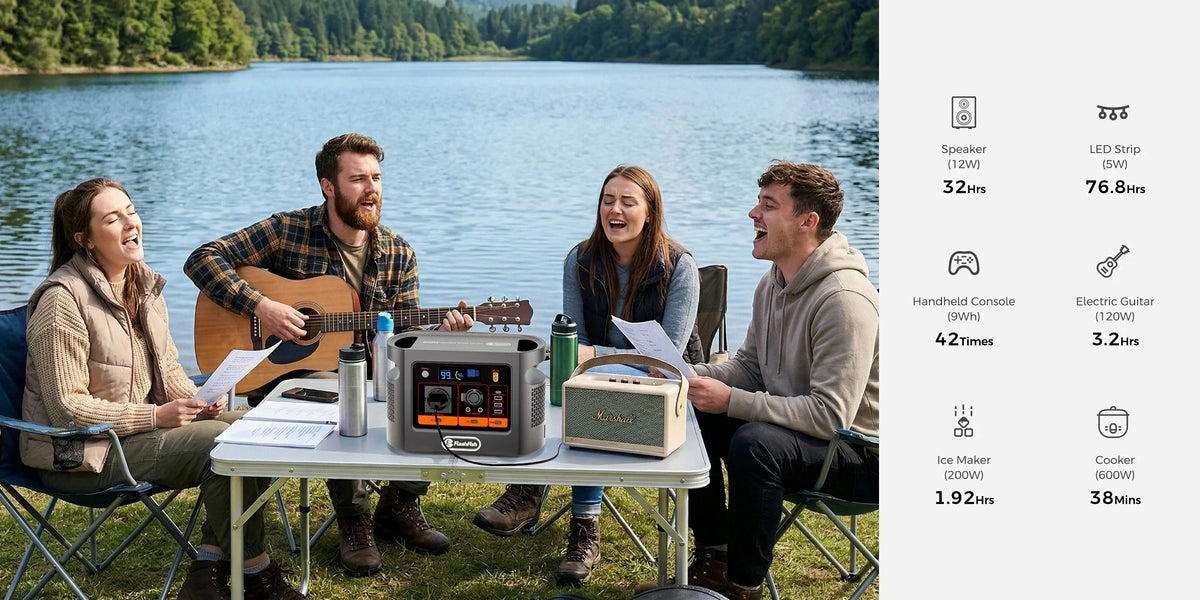
Short answer: FlashFish E106B can be screened for a 12V tyre inflator only when four items are verified together: voltage, maximum current, total shared DC load and the inflator's permitted pump time. E106B documents 12V, 10A and 120W shared across its car output and two DC5521 outputs. A matching 12V plug alone does not prove connector fit, polarity, starting demand, duty cycle or safe tyre service.
The practical method is V-A-T-P: volts, amps, total shared load, permitted pump time. Stop the screen when any one field is missing rather than turning a catalogue watt figure into a compatibility claim.
The V-A-T-P screen
| Check | What to copy | Pass condition |
|---|---|---|
| Volts and connector | Inflator input voltage, exact plug, polarity and any fuse | The delivered inflator and E106B car output have a documented electrical and mechanical match. |
| Maximum amps | Maximum or start current—not only nominal watts | The documented demand stays below the source and connector limits with margin. |
| Total shared DC load | Inflator plus both DC5521 loads and the car outlet | The whole group stays within 12V, 10A and 120W; sockets are not separate power supplies. |
| Permitted pump time | Maximum continuous operation, cooling interval and stop warnings | The planned pressure correction fits the exact manual and leaves a safe stop point. |
Decision step: Compare the inflator label with E106B's shared DC limit before connecting anything.
Why watts alone are not enough
The discontinued Ring RAC610 is a useful label example, not a recommendation. Ring lists 12V DC, 85W and a maximum current of 10A. E106B's car/DC group is also documented at 12V and 10A shared. Therefore the current label reaches the group ceiling even though 85W looks lower than 120W. That leaves no documented allowance for another simultaneous DC load, and it still does not prove motor start behaviour or plug compatibility.
The Continental ContiMobilityKit factsheet gives another 12V, maximum-10A example. Its operating instructions limit compressor operation to 10 minutes. That limit belongs to the exact Continental kit; another inflator may have a shorter, longer or differently defined cycle.
Three plans that should not be merged
1. Routine pressure correction
Use the vehicle placard or owner manual for the target pressure, inspect the tyre first, and record the exact inflator stop method. A short top-up is not evidence for a full inflation from flat.
2. Emergency puncture kit
A sealant-and-compressor kit has product-specific puncture, pressure, distance and speed instructions. Follow that kit's manual. Do not reuse those instructions for a plain inflator or treat portable power as permission to continue driving.
3. Campsite or garage inflator use
Keep the station and connectors dry, stable and ventilated. Route the cable away from traffic and moving parts. Do not run another car-socket or DC5521 device from the same shared group unless the combined maximum demand is documented within the limit.
Supervised test checklist
- Photograph or transcribe the inflator model, voltage, maximum current, plug, fuse and duty-cycle wording.
- Verify the E106B regional label, car-output connector and shared DC group in the current manual.
- Turn off every other DC5521 and car-output load; do not use an improvised adapter.
- Inspect the tyre, valve, hose, plug and cable before use and set the vehicle-manufacturer pressure target.
- Run the inflator within its own manual, watching station warnings, current where safely measurable, plug or cable heat and pressure rise.
- Stop at the manufacturer limit or sooner on abnormal noise, heat, odour, damaged cable, warning or failure to build pressure.
When FlashFish E106B fits
- The exact inflator is documented for 12V and its connector, polarity and maximum current match the E106B car output.
- No other device consumes the shared DC group during the pressure task.
- The manufacturer duty cycle and pressure instructions are available and can be followed.
- The stationary test is dry, supervised and clear of traffic, moving parts and combustible material.
- A separate roadside or professional-help plan exists for a damaged tyre or failed inflation.
When it does not fit
- The maximum or start current, polarity, fuse, connector or duty cycle is unknown.
- The plan assumes two DC5521 sockets plus the car outlet provide independent 120W budgets.
- An adapter is improvised, rewired or used without documented current and polarity.
- The tyre has visible damage, will not hold pressure or the kit manual says to stop.
- The task is jump-starting, tyre repair or roadside recovery rather than powering a verified inflator.
Frequently asked questions
Can E106B run any 12V tyre inflator?
No blanket answer is defensible. Check the exact inflator voltage, maximum current, plug and polarity, manufacturer duty cycle and every other active device in E106B's shared 12V, 10A, 120W DC group.
Is an 85W inflator automatically safe on a 120W output?
Not automatically. A separate maximum-current label can be more restrictive, motor start demand may differ from the watt figure, and the source connector and shared group must also match.
Can I use the E106B DC5521 sockets with a cigarette-lighter adapter?
Only if the exact adapter, connector dimensions, polarity and current rating are documented for both products. Do not improvise an adapter or assume the two DC5521 sockets add independent capacity.
How long can the inflator run continuously?
Use the exact inflator manual. The Continental example limits compressor operation to 10 minutes, but that limit must not be transferred to another inflator.
Does 384Wh tell me how many tyres E106B can inflate?
No. Tyre volume, starting pressure, target pressure, ambient conditions, motor duty cycle, losses and actual compressor demand all change the result. Measure the exact workflow instead of promising a count.
Before relying on the setup: Ask FlashFish support to review the exact 12V plug and current label, then test the delivered equipment under supervision.
Sources and evidence limits
Checked 11 October 2026. E106B facts come from the authoritative local manual-derived record and current Europe product page. Continental supplies one exact 12V, maximum-10A emergency-compressor example and its own operating limit; Ring supplies a second label example and marks that model discontinued. Continental's tyre checklist supports the broader inspection context. FlashFish publishes this guide. No inflator, plug, adapter, tyre, pressure result, current trace or inflation time was tested with E106B, and the image is travel context rather than evidence.



Laisser un commentaire
Ce site est protégé par hCaptcha, et la Politique de confidentialité et les Conditions de service de hCaptcha s’appliquent.