

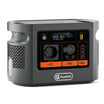
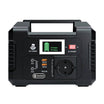

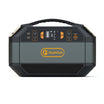
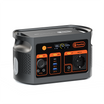







Short answer: E106B is a candidate for an occasional indoor laminating job when the exact machine and every simultaneous AC load fit its documented 600W continuous output. It is not suitable for every A4 laminator. The cited Fellowes Ion revision lists 300W, whereas the Pixel A4 manual lists 782W. The first clears an initial watt screen; the second exceeds it before you add anything else.
Start with the machine label, not the paper size. Then confirm the regional power requirements, warm-up behaviour, indoor workspace and energy needed for the complete job. This guide is a document-based planning screen. We have not connected or tested either laminator with E106B.
Why a laminator needs a different plan from a phone charger
A laminating job has a beginning, a working period and a finish. The rollers must reach operating temperature before the first pouch, documents arrive in batches, and the machine may sit ready between batches. A small input while waiting does not describe the whole session. For a registration desk, preparing signs before visitors arrive can be more useful than keeping a laminator hot throughout the event.
Define the actual deliverable: a few identification inserts, replacement price cards or a prepared set of notices. If the job can be completed earlier using normal mains power, that removes a heater from the temporary desk altogether. If on-site changes are essential, plan the exact machine and workflow rather than buying a station from a generic office-device list.
Documented facts and the first pass/fail check
| Item | Documented value | Planning consequence |
|---|---|---|
| E106B AC output | 600W shared continuous, pure sine wave; one outlet | All connected AC appliances must stay within the station ceiling. |
| E106B stored energy | 384Wh nominal | Energy rating is separate from the maximum instantaneous load. |
| E106B regional output | 110V or 230V and 50/60Hz by regional version | Verify the delivered Europe label rather than choosing a version by model name alone. |
| Fellowes Ion EU revision B | 300W; 220-240V AC, 50/60Hz | Clears the first watt screen, subject to exact-unit and whole-session checks. |
| Fellowes Pixel A4 cited EU manual | 782W | Above 600W; reject this pairing on the continuous-rating screen. |
The numerical examples come from the identified Ion manual and Pixel manual. Check your delivered machine: an archived manual for another revision is not its nameplate.
Next step: Compare E106B with your exact workstation load list before deciding whether its output, energy and carry size fit the job.
A worksheet for the complete workstation
| Check | Write down | What would stop the plan? |
|---|---|---|
| Exact machine | Model, revision, voltage/frequency and maximum input | Unknown label or a mismatched regional supply. |
| Concurrent equipment | Every AC load during warm-up and feeding; USB devices separately | Combined AC demand exceeds 600W or another documented group limit. |
| Job sequence | Warm-up, a representative feed batch, waiting and shutdown | Only an idle display reading has been recorded. |
| Workspace | Dry indoor bench, exit space, heat separation and accessible cable route | Manufacturer instructions do not permit the location. |
| Fallback | Pre-laminated documents or a mains-powered indoor work area | The event depends on an untested arrangement with no alternative. |
Use the station label and appliance instructions together. A multiway extension only adds connection positions. It cannot enlarge the inverter ceiling, and its own rating and condition still matter. Keep AC accounting separate from USB-C accounting; do not subtract a USB charger label from a total and assume that proves the whole mixed-output setup is approved.
Three examples that change the decision
1. One 300W example in a controlled indoor room
The cited Ion rating leaves numerical space under 600W. That makes a careful exact-unit check worthwhile; it does not establish that every warm-up, control setting or pouch batch has been tested. Keep other equipment out of the initial trial and follow the machine instructions throughout.
2. A 782W machine with no other appliances
The cited Pixel example already exceeds the continuous limit. Fewer pouches do not lower its nameplate requirement into the permitted range. An undocumented station peak value is not a basis for running a sustained heating task above the continuous rating.
3. A 300W laminator plus a hypothetical 400W AC task
This teaching example totals 700W if both operate together. Both individual numbers may look modest, yet their sum fails the 600W screen. Separate the tasks or choose a documented setup that accommodates the real simultaneous load; do not keep retrying a protection shutdown.
Measure job energy without inventing a sheet count
Record the full intended session, including warm-up and pauses. A compatible meter can record energy at its measurement point; the station display is useful observation but should not be treated as laboratory calibration. Note which reading describes the appliance path and which describes remaining station energy.
For a constant-load teaching model, watts multiplied by hours gives watt-hours. A thermostat-controlled job is better represented by energy recorded over the full sequence. Conversion losses, idle overhead, battery condition and other loads mean that 384Wh cannot simply be divided by a brief low display value to promise a working time. No efficiency or number of completed laminations has been measured here.
Where E106B fits, and when to change the workflow
E106B belongs on the shortlist when the exact low-demand machine fits its continuous envelope, one accessible AC connection is enough, and the 5.2kg station is manageable alongside the office kit. Its pure-sine specification supplies useful waveform evidence, but the exact appliance requirements still decide the pairing.
Change the plan if the machine exceeds 600W, the event requires a busy continuous production line, the workspace is damp, or the instructions rule out the intended location. A higher-powered machine may justify a different station class, a venue socket or earlier preparation. More battery watt-hours alone cannot fix an output-limit mismatch.
Workspace boundary: use a stable dry indoor bench, preserve ventilation and feed clearance, keep leads away from hot parts, and stop on damage, unusual heat, burning smell or repeated trips. Follow the exact manual for any jam; this article supplies no opening, repair or protection-bypass procedure.
Frequently asked questions
Can E106B run every A4 laminator?
No. Paper format does not establish electrical demand. The cited Ion revision lists 300W, while the Pixel A4 manual lists 782W. The latter exceeds E106B's documented 600W continuous AC ceiling.
Does 384Wh tell me how many sheets I can laminate?
No. Warm-up, thermostat cycling, feeding, idle time, conversion losses and other loads change session energy. Measure the complete intended job before estimating any repeat count.
Can I use a printer at the same time?
Only after checking the printer's own input and the combined simultaneous demand against all relevant limits. E106B has one AC outlet; adding an extension does not increase its 600W AC ceiling.
Can I use the cited Ion laminator on an outdoor stall?
The cited Ion manual says indoor use only. A canopy or portable battery does not change that instruction. Choose a suitable indoor workspace or complete the lamination beforehand.
What should I send FlashFish support before buying?
Send the exact laminator model and manual revision, regional voltage/frequency label, maximum input, other loads, planned indoor placement and job duration. Ask about the specific power path rather than universal compatibility.
Before purchase: Ask about your laminator label and complete setup, including the other equipment and intended work sequence.
Sources and evidence limits
Checked 7 October 2026. E106B specifications are from the authoritative FlashFish manual-derived local record; the Europe page is the current model route. Fellowes manuals identify the bounded appliance examples. Electrical Safety First supports general extension-load and cable cautions; its UK guidance does not establish the station's protection topology or local venue approval. FlashFish publishes this guide. There is no independent test, owner quotation or observed lamination result.





Laisser un commentaire
Ce site est protégé par hCaptcha, et la Politique de confidentialité et les Conditions de service de hCaptcha s’appliquent.