

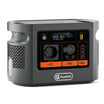
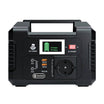

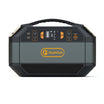
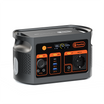


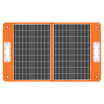
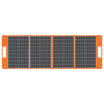


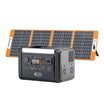

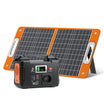


Evidence boundary: no tool charger or allotment setup was tested for this guide. The FlashFish figures below are product specifications, while the Bosch manual is one charger example—not a universal garden-tool specification.
Use PLOT before choosing a station
| PLOT step | Evidence to record | Stop condition |
|---|---|---|
| P — Plug and mains label | Exact charger model, input volts, hertz, watts or amps, plug, manual and any ventilation limits. | Unreadable or wrong-region label, missing manual, improvised voltage conversion or damaged plug. |
| L — Load stack | Measured AC input for every charger and other device that will operate at the same time. | The plan adds battery-side amps, assumes all chargers are identical or ignores simultaneous loads. |
| O — Outdoor arrangement | Dry covered position, stable surface, ventilation, protected cable route, site permission and stop rule. | Rain, condensation, closed hot box, damaged lead, wound reel, public trip hazard or unsuitable equipment. |
| T — Time and energy | Measured Wh for one representative charge, number of cycles, conversion loss and deliberate reserve. | The plan divides rated station Wh by a catalogue number and treats the answer as a fixed cycle count. |
Why this catches a common error: the Bosch AL 18V-44 instructions list a 4.4A charging current for 14.4–18V batteries. That is not a 4.4A draw from a 230V socket. The manual tells the user to match the power source to the charger rating plate; the exact mains-input field or suitable wall-side measurement should lead.
T1200S or T2000: screen the charger bank, not the tool brand
| Published Europe specification | FlashFish T1200S | FlashFish T2000 | Decision meaning |
|---|---|---|---|
| Rated battery capacity | 768Wh | 1536Wh | Planning input, not AC energy delivered to batteries. |
| Continuous AC output | 1200W | 2000W | Compare with the measured simultaneous charger bank and other AC loads. |
| Peak value | 2400W | 4000W | Do not use a peak headline as the continuous planning limit. |
| AC outlets | 4 | 4 | Outlet count does not raise the total output limit or approve a multi-adaptor chain. |
| Approximate mass | 12.45kg | 19.2kg | Include the carry from vehicle, gate or shed in the decision. |
T1200S is the more portable of these two by published mass. T2000 offers twice the rated capacity and a higher continuous-output class, but it is heavier. That makes T2000 a stronger candidate for a larger measured charger bank or more cycles—not automatically the better allotment choice.
Decision step: Compare T1200S and T2000 with your completed PLOT sheet.
Build one measured charging-cycle worksheet
| Charger | Mains-input label | Measured watts | Measured charge time | Observed Wh | Cycles planned |
|---|---|---|---|---|---|
| Charger A | Record exact V/Hz/W or A | Measure safely | Representative battery | W × h or meter reading | Enter need |
| Charger B | Record exact V/Hz/W or A | Measure safely | Representative battery | W × h or meter reading | Enter need |
| Other load | Record exact label | Measure safely | Time active | W × h | Enter need |
Test one normal charging cycle with the exact charger and a representative battery state. Add every observed Wh value, then allow for station AC conversion, charger loss, temperature, battery condition and reserve. If two chargers will operate together, also compare their simultaneous measured watts with the continuous AC limit.
Set up a dry, supervised charging point
- Check the allotment agreement and local rules before bringing or charging batteries.
- Place the station and chargers on a dry, stable, ventilated surface away from combustible storage and public paths.
- Use correctly rated, undamaged connections. Keep them dry, fully unwind any permitted cable reel and do not daisy-chain extension devices.
- Start one charger, observe normal operation, then add only the loads already included in the PLOT sheet.
- Stop for rain, condensation, heat, smell, damage, abnormal charger behaviour or repeated protective trips.
When FlashFish fits—and when it does not
When FlashFish fits
- The exact European charger labels match the delivered station output and every simultaneous load stays inside the continuous limit.
- A measured energy plan leaves reserve, and the published mass suits the route to the charging point.
- The allotment permits a dry, stable, ventilated and supervised arrangement.
When FlashFish does not fit
- Charger labels are missing, the regional supply is wrong or compatibility depends on an improvised adaptor or voltage converter.
- The site is wet, unsupervised, unventilated or unable to protect cables and equipment.
- The task depends on a fixed battery count without a measured cycle and non-battery fallback.
FAQ
Can I size a power station from the tool battery's volts and amp-hours?
Not by themselves. Start with the exact charger's mains-input label and manual, then measure the charger at the wall if a suitable method is available. Battery voltage and capacity describe a different side of the charging system.
Does a 4.4A charging current mean the charger draws 4.4A from a 230V socket?
No. In the cited Bosch manual, 4.4A is the battery-side charging current. Use the charger's mains-input rating or a suitable measurement; do not multiply 4.4A by 230V.
Should I choose T1200S or T2000 for several chargers?
Add the measured simultaneous AC inputs and build an energy budget for the number of charging cycles. T1200S is the lighter published option; T2000 provides more published capacity and continuous output but is heavier.
Can I run chargers outside in rain or inside a closed shed?
Do not expose the station, chargers or connections to rain or condensation. A shed also needs a dry, stable, ventilated arrangement that follows every manual and site rule. Stop if those conditions cannot be maintained.
How many tool batteries will a portable power station recharge?
This draft does not promise a count. Battery size, state of charge, charger losses, station conversion losses, temperature and reserve all matter. Measure one representative cycle, then plan a conservative range.
Sources and evidence notes
- FlashFish Europe T1200S, FlashFish Europe T2000 and the local product database — current product identity and published station limits.
- Bosch AL 18V-44 original instructions — exact-charger label method and battery-side current example.
- Electrical Safety First garden guidance — outdoor connection and cable boundaries.
Editorial viewpoint: an allotment power decision begins on the charger input label, not on the tool battery. PLOT makes the charger bank, site and energy evidence visible before capacity is purchased.
Next step: Review the T1200S specification for a smaller charger bank after filling the worksheet.
Evidence checked . Human review is required for exact regional manuals, allotment rules, electrical wording, author/reviewer credentials, links, metadata, image context and rendered FAQ/schema parity before publication.




Laisser un commentaire
Ce site est protégé par hCaptcha, et la Politique de confidentialité et les Conditions de service de hCaptcha s’appliquent.