

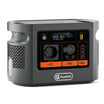
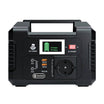

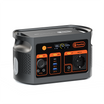







Short answer: choose P66A when a compact 18W USB-C path and its documented 230V EU record match your small-device kit, but stop if the appliance requires waveform evidence because the authoritative P66A record does not provide it. Choose E200 when its lighter listed mass, USB-A paths and documented modified-sine boundary fit devices that explicitly accept that supply. Both share a 200W continuous AC rating; that tie does not make them interchangeable.
Use SAME-200 instead of choosing by watts alone
SAME-200 means: hold the Same 200W continuous ceiling constant, compare AC waveform and regional evidence, map Mobile USB and DC paths, then expose every Evidence gap before buying. This method gives unknown fields a real cost instead of rewarding whichever product page looks more complete.
Equal-field comparison
| Field | FlashFish P66A | FlashFish E200 | Decision meaning |
|---|---|---|---|
| Nominal energy | 144.3Wh in EU manual; storefront title displays 144.34Wh | 151Wh nominal | Neither is measured delivered energy |
| Continuous AC | 200W at 230V | 200W; 400W peak; EU 230V version | Keep real running load below the continuous ceiling |
| Waveform | Not provided in authoritative local record | Modified sine wave | Stop on waveform-sensitive loads unless the device and station evidence match |
| USB-C | One QC-labelled USB-C up to 18W | No documented USB-C | Check the actual source, cable and sink profile |
| Other USB | Two 12W USB-A plus one 18W QC USB-A | Two 18W QC USB-A plus one 12W USB-A | Count ports and per-port limits, not connector count alone |
| Listed mass | 2kg | About 1.85kg | Add charger and cable mass to the whole-kit comparison |
| Chemistry | Not provided in local record | Lithium-ion, 18650 | Do not fill a blank from a related model |
What each product does well on paper
P66A: the EU manual-derived record is explicit about 230V AC, its 200W ceiling, an 18W USB-C path, multiple 12V outputs and 2kg mass. It can be a simpler connector fit for a phone, camera accessory or other low-power USB-C device when 18W and the actual protocol are enough.
E200: the record clearly identifies modified-sine AC, a 200W continuous and 400W peak rating, QC USB-A outputs, lithium-ion chemistry and a slightly lower listed mass. That waveform disclosure is useful because it helps buyers reject unsuitable AC loads rather than assuming every 200W outlet behaves the same.
Three concrete buyer profiles
- Phone, small camera charger and USB-C accessory: P66A may reduce the need for a separate AC adapter when the accessory accepts a matching 18W USB-C profile. Confirm the exact cable and device input; connector shape is not enough.
- USB-A-first emergency kit: E200 can be the clearer fit when the kit uses documented QC USB-A and no waveform-sensitive AC device. Its modified-sine output remains a boundary, not a defect that can be ignored.
- Sensitive AC instrument or motor: neither is an automatic recommendation. E200 is documented modified sine, while P66A waveform is unknown; choose a station whose current manual explicitly matches the device requirement.
When P66A fits
- Your primary loads stay below 200W continuous and do not require an unsupported peak or waveform claim.
- A documented 18W USB-C path is useful for the exact device and cable.
- The delivered 230V regional label, plug and current manual match your market.
- You accept that chemistry, frequency and waveform remain unknown in the authoritative local record until verified.
When E200 fits
- Your kit is USB-A or 12V focused and each device stays within its documented port limit.
- Any AC device explicitly accepts modified-sine supply and remains below 200W continuous.
- The slightly lower listed station mass matters after including the charger and cables.
- You do not need USB-C, UPS/EPS, a fixed runtime or an inferred frequency value.
When neither fits
- The real continuous AC load exceeds 200W or the device has an unknown starting demand.
- The device requires pure sine output and you cannot prove the selected station provides it.
- You need USB-C above 18W, a verified laptop Power Delivery profile or automatic backup switching.
- You need a tested runtime, independent reliability result, weather-resistance rating or promised charge count.
Common comparison mistakes
- Treating the shared 200W headline as evidence of equal waveform, ports or device fit.
- Calling 144.3Wh and 151Wh usable output energy without a measured path.
- Assuming P66A USB-C means laptop charging at any requested profile.
- Ignoring E200's modified-sine boundary for audio, motor, medical or precision equipment.
- Filling P66A chemistry, waveform or frequency from another FlashFish model.
FAQ
What is the main difference between P66A and E200?
Both list 200W continuous AC, but P66A has a documented 18W USB-C path and unknown waveform in the local record; E200 has documented modified-sine AC and no documented USB-C.
Which has more battery capacity?
P66A is 144.3Wh in its EU manual, while E200 is 151Wh nominal. Neither number is a measured delivered-energy result.
Which is lighter?
E200 is listed at about 1.85kg and P66A at 2kg. Compare the full carried kit, not the station alone.
Is P66A better for USB-C devices?
It has an 18W USB-C output, while E200 has no documented USB-C. Verify the exact protocol, cable and device input before treating that as a fit.
Which is better for sensitive AC equipment?
Do not choose from watts alone. E200 is modified sine, while P66A waveform is unknown in the local record; use a model with confirmed matching waveform evidence for the exact device.
Sources and evidence limits
- FlashFish P66A Europe page, used with the EU manual-derived local record.
- FlashFish E200 Europe page, used with the authoritative local record.
- USB-IF Power Delivery overview, used for source-cable-sink negotiation boundaries.
- FlashFish Europe Support Center, used as the exact-model manual and escalation route.
No P66A, E200 or connected device was tested. Check P66A after scoring your SAME-200 device paths, or Check E200 only for loads that accept its documented output path. Compare other verified portable power station limits when neither model clears the evidence gate.




Laisser un commentaire
Ce site est protégé par hCaptcha, et la Politique de confidentialité et les Conditions de service de hCaptcha s’appliquent.