







How Much Does It Cost to Recharge a Power Station?
Use METER-TARIFF-COST: measure the complete wall-energy session, identify the tariff that applies during it, then multiply before rounding and recording conditions.

Portable Power Station Net Weight vs Shipping Weight
A weight number is useful only when its boundary is clear. Compare the unit, inner box, outer carton and complete carried kit separately before making a buying or packing decision.

Power Lifting vs Surge Watts: What Buyers Should Know
A four-label screen separates sustained output, short surge, manufacturer-specific voltage-adjusting boost modes and stored energy before any appliance decision.

Why a 65W Charger Does Not Always Draw 65W
RATED separates the nameplate ceiling, negotiated demand, task phase, efficiency path and direct measurement so buyers stop treating 65W as constant draw or session energy.

Why a Portable Power Station Fan Runs After the Load Stops
FAN records the function before the event, airflow and ambient conditions, noise character and time pattern so users can distinguish a plausible cool-down cycle from a stop-and-support case.

Why a USB Power Meter and Power Station Display Disagree
POINT asks where the reading is taken, when it is sampled, which unit is shown, what USB state was negotiated and whether test conditions stayed constant.

Should You Calibrate a Portable Power Station Battery?
CHECK treats calibration as a model-specific gauge procedure, not a generic battery cure: capture the symptom, use the exact handbook, execute only authorised steps and confirm the result.
Can You Take a Portable Power Station on a Plane?
BOARD separates Battery rating, Operator policy, Appropriate baggage, Risk condition and Documentation so an under-100Wh label is not mistaken for acceptance.

CE Marking on Portable Power Stations: What It Means
MARK turns a logo check into an exact-model evidence process: Match the product, identify Applicable rules, Read the declaration and Keep the product within documented use.
How to Check a Replacement Power Station Charger
VOLTS-CURRENT-POLARITY-CONNECTOR-AUTHORITY treats every label field as a gate: physical fit is never enough, and one mismatch sends the reader to the exact manual or support.

Cold-to-Warm Condensation and Portable Power Stations
COLD means Cut power, Observe the environment and manual, Let the unit acclimatise naturally, and Dry-inspect-escalate before use is reconsidered.
Why Cable Watts Do Not Guarantee USB-C Charging Speed
Cable watts are a ceiling, not a promise. SOURCE-CABLE-SINK makes the source profile, cable capability and receiving device's negotiated request visible before anyone blames the cable or expects he...

DC Barrel Polarity Symbols: A Safe Matching Guide
A matching barrel shape proves almost nothing. MATCH turns the polarity mark into one part of a five-field decision: model authority, electrical ratings, tip/sleeve polarity, connector dimensions a...

Product Page vs Manual: Resolving Power Station Specs
A specification conflict is an identity problem before it is a number problem. The SOURCE method checks exact model, region, revision, rating definition, product label and escalation path while pre...

What Duty Cycle Means for Power Station Runtime Planning
Duty cycle converts an intermittent load into time-weighted energy. The ON/OFF/MEASURE worksheet separates active, idle and startup states before using any runtime calculator.
Why AC No-Load Power Matters on a Camping Trip
An enabled AC inverter can draw energy even when its socket has no useful load. No-load watts are model-specific; a practical trip plan measures the exact station and avoids borrowing another model...
50Hz vs 60Hz on Portable Power Stations in Europe
A European plug and a 230V label are not enough: the station output and appliance input must also agree on frequency. LABEL MATCH turns 50Hz versus 60Hz into a safe stop-or-proceed check without gi...

Can One Portable Power Station Charge Another?
Sometimes one station can power another station's original AC charger, but it is an energy transfer with conversion losses—not a larger shared battery. Use the TRANSFER method and stop when any vol...
Nominal Wh vs Delivered Energy: Read Power Station Tests
Define the measurement boundary before calculating an energy ratio. A copyable test-report card separates battery labels, output-meter results, charger inputs and incomplete sessions.

Why a 60W Solar Panel Does Not Give E200 60W Input
Use THREE CEILINGS—panel nameplate, electrical fit and station acceptance—to explain why E200's documented 40W input limit remains decisive before sunlight and conversion losses are considered.

Portable Power Station THD: What Pure Sine Wave Does Not Prove
Use PROOF to keep a waveform label separate from a numeric THD result: identify the parameter, required device evidence, operating load and measurement method before comparing stations.
What Does Shared 120W Mean on the E106B 12V Outputs?
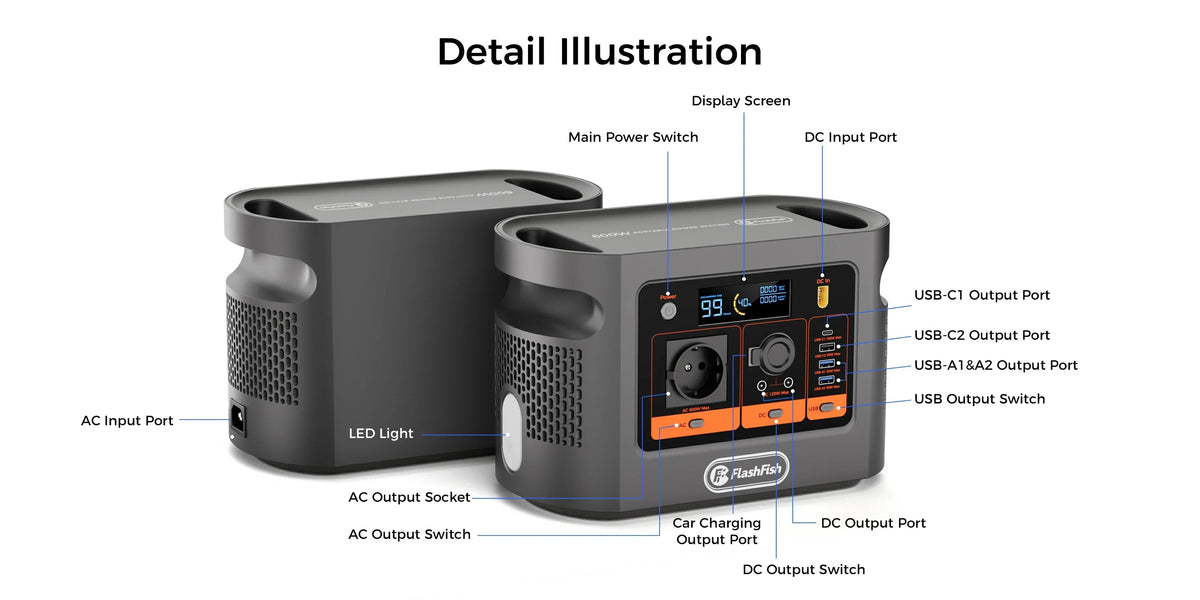
Use BUDGET to treat the E106B's two DC5521 ports and car socket as one documented 12V, 10A, 120W output group rather than three separate 120W supplies.
Calendar Ageing vs Cycle Ageing in Portable Power Stations
Use TWO CLOCKS to judge battery-life evidence by both time at real conditions and charge-discharge throughput, then check temperature, state of charge and test endpoints.
What Counts as One Battery Cycle in a Portable Power Station?
A battery cycle usually describes cumulative charge-discharge throughput, but meaningful comparison also needs operating window, test conditions, end criterion and calendar time.