

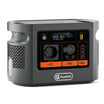
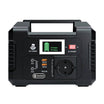

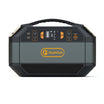
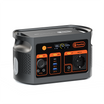




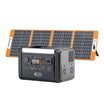

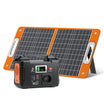

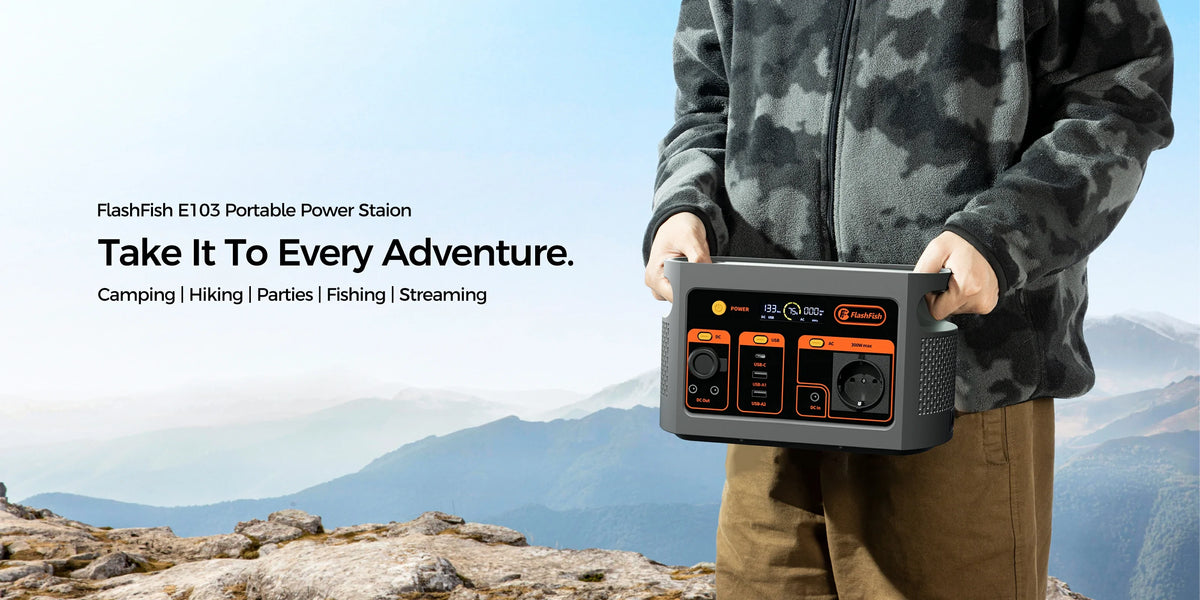
Short answer: start with the bag and the approved charging route. E103 offers a larger documented station envelope at 179.2Wh and 300W continuous AC; the retail Omni 20+ is much lighter and may suit a small daily kit. Neither is automatically the better laptop charger. Your original charger, accepted USB profiles, measured session energy and regional variant decide.
This is a neutral comparison for European laptop and camera users, written by FlashFish. It uses local product records and current manufacturer documentation, rather than a side-by-side field test. No price, noise, reliability or duration advantage is claimed. A light bag can be the right answer even when its power source has a smaller label.
In this guide: Exact versions · Same-definition comparison · Bag-first decision · Three examples · FAQ
Fix the exact products before comparing them
We compare the EU E103 with the retail Omnicharge Omni 20+ page identifying SKU OP2HA004. The latter documents a European AC version. Omnicharge’s docking replacement, Omni Power 20+, and the USB-focused Omni 20C+ are separate products; a similar name is not authority to exchange their specifications.
Before ordering either product, confirm the delivered regional socket, output voltage and current instructions with the seller. This article does not establish current Omnicharge European stock or shipping. FlashFish’s fresh Europe Admin read confirms E103 has an active public product page and inventory; availability still needs rechecking when you buy.
Compare the same definition, then explain the consequence
| Field | FlashFish E103 local record | Retail Omni 20+ cited specifications |
|---|---|---|
| Nominal energy | 179.2Wh | 71Wh ±5% |
| Continuous AC ceiling | 300W | 100W |
| AC waveform | Pure sine wave | Modified sine wave |
| Highest documented USB-C output | 60W | 60W |
| Listed mass | Approximately 3.0kg | 611g |
| Regional AC check | EU record: 230V | Documented EU version: 230V/50Hz |
Manufacturer specifications describe ceilings and formats, not all possible simultaneous loads. The waveform row matters if an appliance maker specifies a requirement; it does not establish that one product will work with every device or that the other will fail. Ask for device-specific acceptance when the charger or equipment instructions are unclear.
The power-bank form saves substantial carry weight in this exact comparison. The station form provides a larger documented energy and AC envelope. A ratio between nominal labels is not a ratio between measured runtime. We have no comparable delivered-energy dataset, so the choice stays with the workload and bag rather than an invented efficiency percentage.
A bag-first decision you can use today
- Required path: does the laptop or camera accept direct USB-C charging, or does the task require its original AC adapter? Check the device manual, not just the plug shape.
- Session energy: record energy used by a representative session or request a transparent test for the exact load. Include the jobs that occur before access to another charger.
- Packed burden: weigh the source with its charging lead, device adapters and cables. A unit’s mass alone is not the whole kit.
- Recharge opportunity: identify the approved charging method and the next practical chance to use it. Do not assume a solar panel or every charging accessory comes with either source.
The Omnicharge compatibility guidance makes the relevant screening distinction: compare AC demand with the rated ceiling and check the device’s USB-PD needs. USB-IF describes negotiated power. For either model, a laptop under heavy workload can behave differently from the same laptop idle; record battery trend and stable operation during the intended task.
Next step: Check E103 against your original charger requirements.
Three examples with different priorities
| Example | Useful next check | Likely decision direction |
|---|---|---|
| Daily train-to-office laptop top-up with documented USB-C charging | Accepted PD profile, representative session energy, actual packed weight | Consider the lighter power-bank format first |
| A fixed camera-and-laptop workspace with an original AC charger | Complete adapter demand and task energy; compare waveform requirements | E103 can be plausible if its larger envelope is needed |
| An original charger whose required AC demand exceeds 100W but remains within E103’s ceiling | Exact input requirement, startup behaviour and regional acceptance | The documented AC ceilings matter; USB-C labels do not replace this check |
These are decision examples, not compatibility results. In the third case, a number below 300W is still only a screen: the exact adapter, source waveform, startup behaviour and manual requirements need checking. Do not present the E103’s output limit as permission to improvise a connection.
When FlashFish fits—and when it is excessive
E103 can fit a compact stationary workspace where approved AC equipment requires a larger documented envelope and roughly 3kg is acceptable. Its 60W USB-C ceiling is useful only when the device accepts the available profile and the real workload remains satisfactory. A small station is also a commitment to carrying and recharging a larger object.
For a light daily bag with modest, verified energy needs, the retail Omni 20+ may be the more practical format. Choosing a larger station purely because the Wh label is bigger can solve a problem you do not have. A simpler USB power bank may also fit a USB-only task; it needs its own exact-model review rather than category-wide assumptions.
Neither comparison establishes an airline decision, a critical-care power arrangement, weather resistance or automatic failover. Do not use adapters to defeat regional outlet requirements or change proprietary battery-charging methods. Stop a trial on damage, abnormal heat, warnings or repeated disconnection and seek the maker’s advice rather than forcing an uncertain path.
Write this on your buying checklist
| Record | Your entry |
|---|---|
| Laptop/camera exact model and approved charger | ________ |
| Required AC input or accepted USB-PD profile | ________ |
| Measured task Wh and stated meter location | ________ |
| Actual packed kit mass and available bag space | ________ |
| Next approved recharge opportunity | ________ |
| Unresolved manufacturer question | ________ |
If one entry is still unknown, that is the next research task. Price shopping is more useful after the source fits the job. Include required cables, adapters and charging hardware in the eventual checkout comparison; this article deliberately supplies no dated-price ranking.
Frequently asked questions
Is an AC power bank the same as a portable power station?
The product names are not a universal technical standard. Compare the actual energy, AC ceiling, waveform, USB profiles, packed mass and documented charging methods of the exact models.
Which Omni 20+ is compared here?
The retail Omni 20+ identified as OP2HA004 on the cited page, with the documented 230V/50Hz EU version. The Omni Power 20+ dock replacement and Omni 20C+ are separate products.
Does E103’s larger Wh value prove a runtime multiplier?
No. Nominal label energy is not measured delivered energy. Different conversion paths, load behaviour, station overhead and stopping conditions prevent a promised multiplier.
Can either option charge any 60W USB-C laptop?
No. A 60W ceiling does not prove the exact negotiated profile or sustained charging under workload. Check the laptop’s charging port, accepted profiles and cable, then test that route.
Which option is better for a small camera bag?
The lighter retail Omni 20+ may fit better if its documented connections and energy envelope meet the task. E103 is more plausible when you need a larger station envelope and can accept its carry burden.
Choose the format that meets the task
Choose a verified charging path with enough documented and measured margin for your task, then take the least burdensome complete kit that meets it. E103’s larger envelope can help when needed; a lighter bank can be a better everyday choice when it already does the job.
Next step: Compare FlashFish stations with your complete carry kit.
Sources and method
Prepared by FlashFish Miles. Checked 17 September 2026. E103 fields use the authoritative local record and Europe E103 page. Omni values refer to the exact retail page linked above; its support article supplies screening guidance. This brand-written analysis contains no physical product test, user quote, independent recommendation, measured runtime or price claim.



Laisser un commentaire
Ce site est protégé par hCaptcha, et la Politique de confidentialité et les Conditions de service de hCaptcha s’appliquent.